Reception at the Embassy of Canada to Poland (+photo gallery)
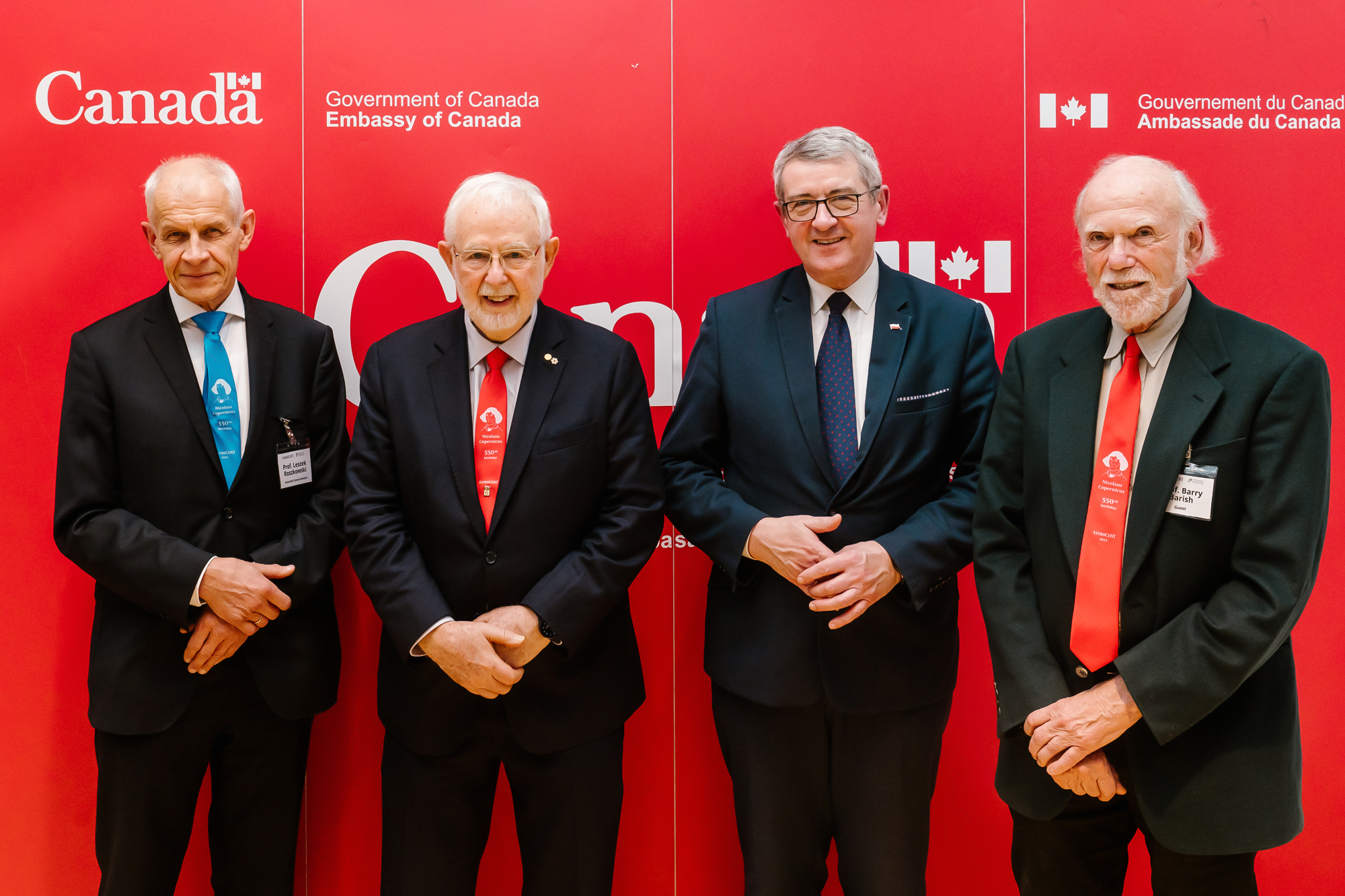
On the 22nd of February, after the public talks by the two Nobel Laureates in Physics organized by AstroCeNT, a reception for the distinguished guests was held at the Embassy of Canada to Poland in Warsaw. The event was dedicated to the cooperation of our countries in the field of research on dark matter (the Global Argon Dark Matter Collaboration), gravitational waves (LIGO/Virgo/KAGRA collaboration) and neutrinos (Hyper-Kamiokande) and was attended by Polish and foreign diplomats, representatives of Polish educational and scientific institutions, Polish scientists and guests from abroad.
During the reception at the Canadian Embassy the importance of international cooperation in promoting scientific research and understanding of the Universe was emphasized. By bringing together experts from different countries and fields, the event provided a space to exchange ideas and forge new partnerships.
The photo gallery from the event can be found👉 👉 👉HERE.
In a communiqué dated 29 December, the Ministry of Science and Higher Education announced its support for the project “Astrocent Plus – Particle Astrophysics Science and Technology Centre (Astrocent Plus)”. The aim of this initiative is to develop the Astrocent Centre of Excellence in the area of fundamental research combined with innovative applied research and development activities in particle astrophysics.
The Ministry will allocate a total of PLN 29.7 million (the equivalent of EUR 7 million) to the Nicolaus Copernicus Astronomical Center of the Polish Academy of Sciences (CAMK PAN). The funds will be disbursed in annual instalments through 2030.
On 19 December, the Foundation for Polish Science announced that it had awarded over PLN 34 million the project “Astrocent – Particle Astrophysics Technology Centre” in the MAB FENG competition.
Project description:
The overarching goal of the project is to develop breakthrough, highly scalable and multi-channel detection systems for scientific and commercial applications. The technologies being developed are crucial for research into the biggest questions of modern physics (including dark matter, neutrinos and gravitational waves), while also opening up new opportunities in areas such as medicine, security, environmental and climate monitoring, renewable energy, and seismology (including early-warning systems).
Share:
We use cookies to ensure that we give you the best experience on our website. If you continue to use this site we will assume that you are happy with it.
You can revoke your consent any time using the Revoke consent button.