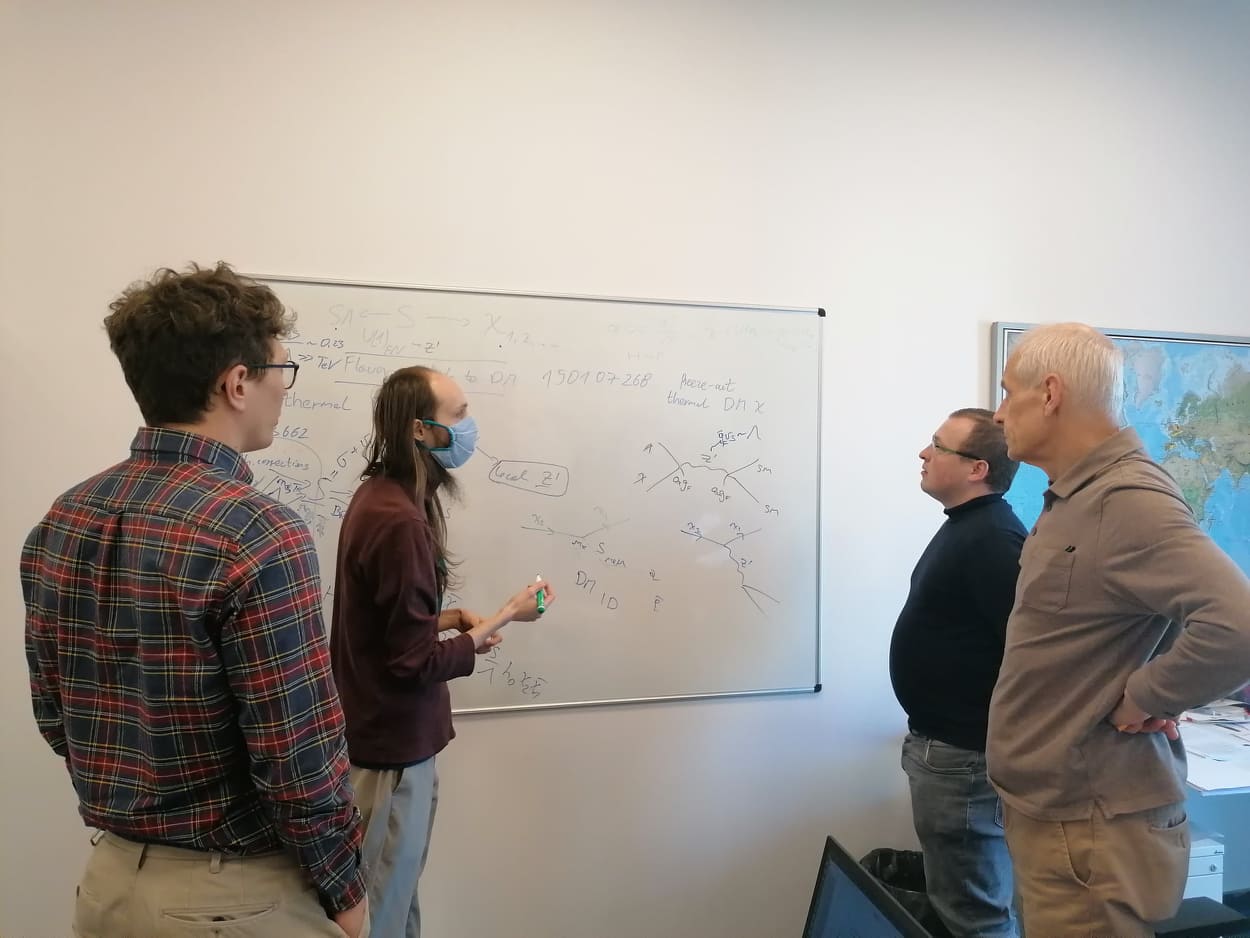
The Particle Astrophysics research group deals primarily with a wide range of physics questions, both theory and experiment. In line with the general agenda of Astrocent, the main areas of research are:
– dark matter;
– gravitational waves.
To date, four postdoc researchers are working in this group under the guidance of Professor Leszek Roszkowski.
Dr Jaksa Osiński’s research has focused on nonstandard expansion histories in the period before big bang nucleosynthesis, and how these histories affect dark matter production. In particular, he is interested in searching for possible connections between current observables and the properties of the very early Universe in order to probe the conditions of the Universe at these early times.
The area of dr Manimala Chakraborti’s research work includes phenomenological aspects of physics beyond the standard model. More precisely, her works involve exploring low energy signatures of various BSM scenarios in the light of precision tests, collider studies and relic density as well as detection prospects of dark matter.
Dr Sebastian Trojanowski is a theoretical physicist specialized in (astro)particle physics and particle cosmology. He is studying possible intriguing connections between predicted heavy and light dark sectors of the Universe.
Dr Andrew Cheek is an astroparticle phenomenologist. He is interested in how theories of the fundamental forces and elements of our Universe implicate phenomena in astrophysical environments and Earth based experiments. So far, his research has focused mainly on the nature of dark matter.
On Wednesday, 3 December 2025, Astrocent’s Director, Leszek Roszkowski, took part in the 8th French‑Polish Forum for Science and Innovation, held at the Ministry of Higher Education, Research and Space in Paris. This year’s edition focused on strengthening collaborations following the signing of the Nancy Treaty of Enhanced Cooperation and Friendship between France and Poland on 9 May 2025.
The Forum brought together high-level representatives of the French Ministry of Higher Education and Research in France and the Ministry of Science and Higher Education of Poland, highlighting the importance of aligning project timelines with market availability of key technologies, ensuring effective collaboration between academia, industry, and funding agencies.
In the afternoon, the delegation visited the AstroParticule & Cosmologie (APC) laboratory at Université Paris Cité.
On November 4, we joined the global celebration of Dark Matter Day 2025 with a public talk by Dr Sebastian Trojanowski, theoretical physicist at Astrocent and the National Centre for Nuclear Research (NCNR).
The lecture took the audience on a journey through one of the biggest mysteries in modern science — the nature of dark matter.
At Astrocent, we believe in sharing knowledge and inspiring curiosity — opening science to everyone, not just researchers. This event was part of that mission and fits perfectly within our Teaming for Excellence project, which builds bridges between science and society.
Share:
We use cookies to ensure that we give you the best experience on our website. If you continue to use this site we will assume that you are happy with it.
You can revoke your consent any time using the Revoke consent button.