Cooperation with INFN on the DarkSide-20k experiment
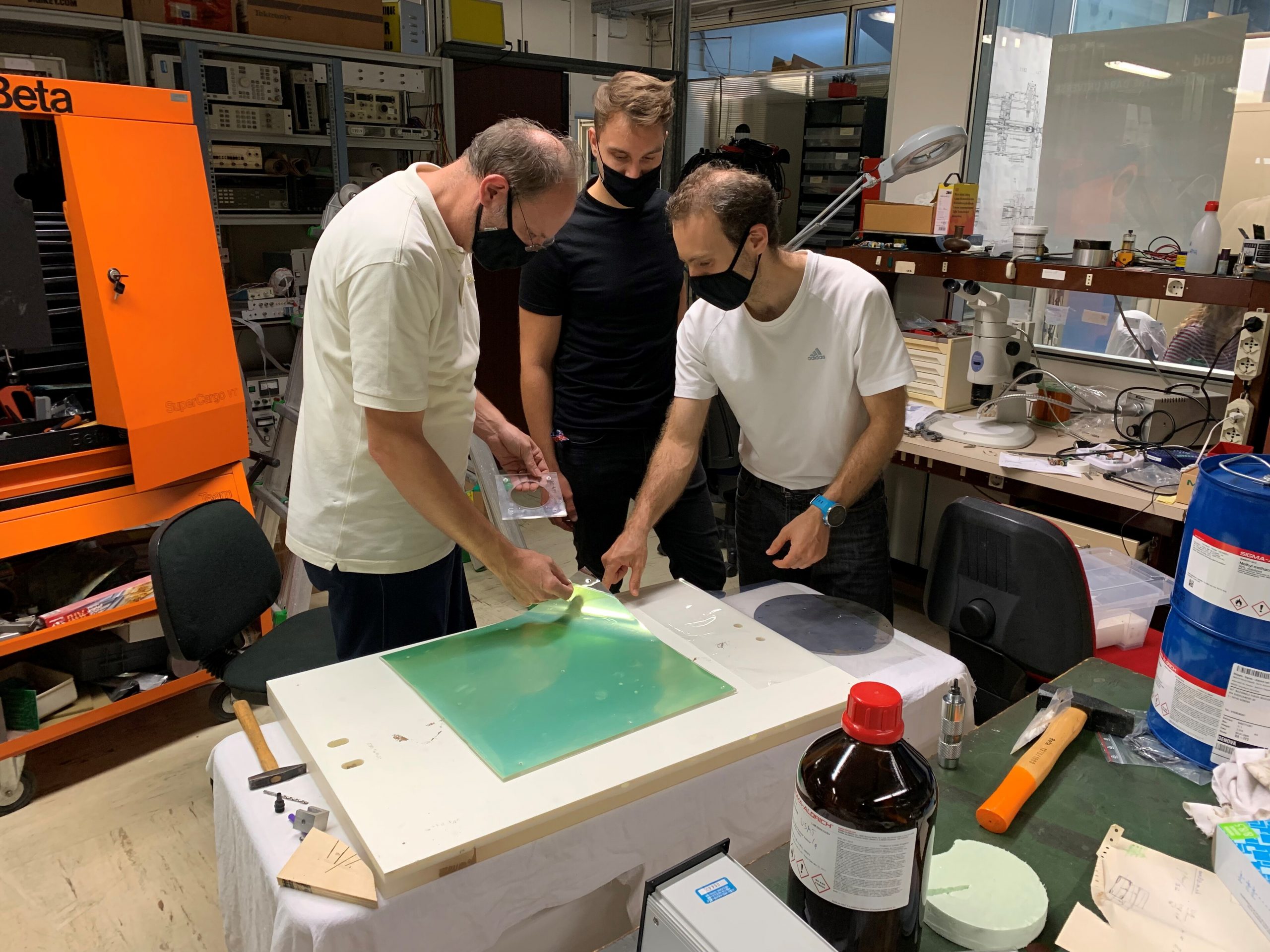
On 2 October 2021 our colleague Dr Marek Walczak (research group 1) returned from a scientific trip to the National Institute of Nuclear Physics (INFN) in Genoa, Italy. He spent three intensive weeks there working on testing the veto Photo Detector Modules and developing software for analyzing data from the tested setups. All this time he collaborated with other INFN scientists from Gemma Testera’s group: Bianca Bottino, Alessio Caminata, Simone Copello and Stefano Davini.
This work was carried out as part of the DarkSide-20k experiment. Its scientific goal is the direct detection of dark matter by observing its interaction with argon nuclei, which would produce a specific light signal.
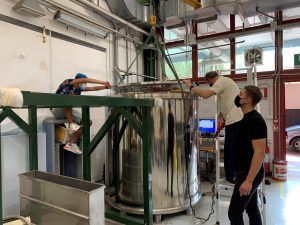
INFN is one of AstroCeNT’s scientific partners and a close collaborator on the DarkSide-20k experiment. In general, INFN is active in all research fields, both theoretical and experimental, related to nuclear and subnuclear physics, particle astrophysics, and gravitational waves. INFN collaborates with universities and national and international research bodies, among with CERN and PSI in Switzerland, Fermilab and JLab in the United States, and the VIRGO-LIGO consortium between Italy and the United States.
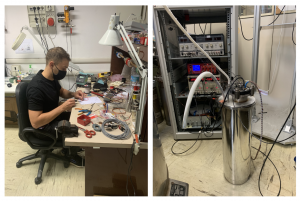
The cooperation between AstroCeNT and INFN is already yielding first results. In the future, we are planning more scientific visits to exchange experience, which will allow us to move forward in our current projects.
In a communiqué dated 29 December, the Ministry of Science and Higher Education announced its support for the project “Astrocent Plus – Particle Astrophysics Science and Technology Centre (Astrocent Plus)”. The aim of this initiative is to develop the Astrocent Centre of Excellence in the area of fundamental research combined with innovative applied research and development activities in particle astrophysics.
The Ministry will allocate a total of PLN 29.7 million (the equivalent of EUR 7 million) to the Nicolaus Copernicus Astronomical Center of the Polish Academy of Sciences (CAMK PAN). The funds will be disbursed in annual instalments through 2030.
On 19 December, the Foundation for Polish Science announced that it had awarded over PLN 34 million the project “Astrocent – Particle Astrophysics Technology Centre” in the MAB FENG competition.
Project description:
The overarching goal of the project is to develop breakthrough, highly scalable and multi-channel detection systems for scientific and commercial applications. The technologies being developed are crucial for research into the biggest questions of modern physics (including dark matter, neutrinos and gravitational waves), while also opening up new opportunities in areas such as medicine, security, environmental and climate monitoring, renewable energy, and seismology (including early-warning systems).
Share:
We use cookies to ensure that we give you the best experience on our website. If you continue to use this site we will assume that you are happy with it.
You can revoke your consent any time using the Revoke consent button.