New Year, but the same determination to unravel dark sector secrets!
An international study published in Nature Astronomy has identified a significant potential impact of interactions between dark matter and neutrinos on cosmological data, offering a fresh perspective on constraining the universe’s “dark sector.” By analyzing weak gravitational lensing – the subtle distortion of light from distant galaxies – researchers found that cosmic matter is distributed more uniformly than the standard cosmological model predicts. This discrepancy can be resolved by accounting for interactions between these elusive particles in the early universe, which may also explain how dark matter was produced shortly after the Big Bang. Ultimately, this research provides a novel pathway toward detecting the first non-gravitational evidence of relic neutrinos, a core prediction of the Hot Big Bang theory.
The research was driven by the team led by Dr. Sebastian Trojanowski (Astrocent, NCAC PAS), with the analysis spearheaded by his team member based at the National Centre for Nuclear Research (NCBJ). Utilizing a novel combination of advanced simulations and machine learning, the team detected subtle cosmic signals that are typically beyond the reach of terrestrial experiments. While these findings align with earlier data from the CMB observations and the Dark Energy Survey (DES), the team anticipates that next-generation tools, such as the Vera C. Rubin Observatory, will provide the final confirmation needed to determine if this interaction represents a fundamental discovery in particle cosmology.
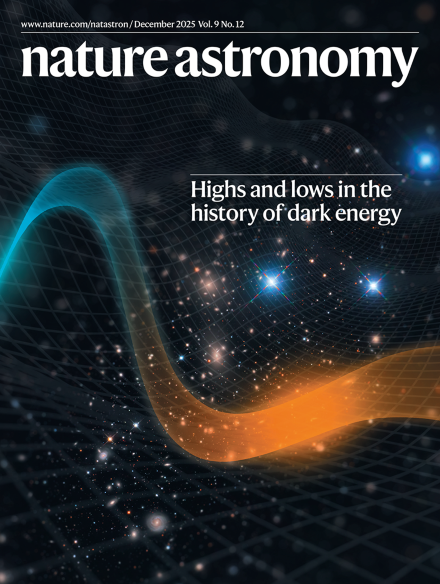
Image: Shaoyu Zhang, Songyan Yang, Chao Zhang, National Astronomical Observatories, Chinese Academy of Sciences.
Cover design: Bethany Vukomanovic